Tree Lighting

A well-lit tree changes everything about a yard after dark. It becomes a focal point, a sculptural element, a vertical anchor that draws the eye and gives the landscape its scale and depth. In Canada, where the seasons reshape the look of every tree — from bare winter silhouettes to dense summer canopies and the blazing color of fall — good tree lights don't just illuminate a tree. They reveal it, season by season, in a completely different way.

in-lite has been designing premium 12V outdoor lighting for over 25 years. Our tree lighting range is built for the conditions that Canadian homeowners face: hard winters, sustained frost, and properties where trees need to look as good under a foot of snow as they do in July.

Tree Lighting - in-liteTree Lighting - in-lite

11Items

  1. 5766_nero.png 5766_nero.png
    gesture swiping hand
    NERO
    Recessed light - Ø 130 mm / 5"
  2. 1526_10400601_1.png 1526_10400601_1.png
    MINI SCOPE
    Spotlight - Light range 3m/9.84ft
  3. 1506_10400503_0.png 1506_10400503_0.png
    SCOPE
    Spotlight - Light range 8m/26.25ft
  4. 5743_big_nero_narrow.png 5743_big_nero_narrow.png
    BIG NERO NARROW
    Recessed light - Ø 142mm / 5.59"
  5. 5744_big_nero.png 5744_big_nero.png
    BIG NERO
    Recessed light - Ø 142 mm / 5.59"
  6. 1573_10401002_0.png
    BIG SCOPE
    Spotlight - Light range 6m/20ft
  7. 1562_10400902_1.png 1562_10400902_1.png
    BIG SCOPE NARROW
    Spotlight - Light range 14m/46ft
  8. 5742_big_flux_b.png 5742_big_flux_b.png
    BIG FLUX
    Recessed light - Ø 60mm / 2.36"
  9. 5736_big_flux_asymmetric_b.png 5736_big_flux_asymmetric_b.png
    BIG FLUX ASYMMETRIC
    Recessed light - Ø 60mm / 2.36"
  10. 5738_big_flux_narrow_b.png 5738_big_flux_narrow_b.png
    BIG FLUX NARROW
    Recessed light - Ø 60mm / 2.36"
  11. 6462_flux_black_1.png 6462_flux_black_1.png
    FLUX
    Outdoor ground spotlight - Ø 60 mm

11Items

Why choose professional tree lighting?

Trees are the vertical structure of your landscape. They create privacy, provide shade, define property boundaries, and establish the character of a yard in a way that no other planting or hardscape feature can replicate. But at night, without lighting, even the most impressive tree becomes invisible. You've invested in the tree, the planting, and the landscaping around it — tree lights let you see that investment after dark.

For Canadian homeowners, this matters across every season. In summer, spotlights catching the movement of full canopy foliage in the wind create a living light show. In autumn, uplighting intensifies the already dramatic reds, oranges, and golds of maples and birches. In winter, the bare branches of deciduous trees — illuminated from below — create bold, graphic silhouettes against a dark sky that are striking in a completely different way to the leafed-out tree. And spring, when buds first appear, becomes something worth watching in the evening rather than only during daylight.

Popular techniques for illuminating trees

How you light a tree and which fixture you use determine the mood it creates. in-lite's tree lighting range covers two main approaches, each producing a completely different effect.

Tree lighting with spotlights

Ground-mounted outdoor spotlights aimed upward into the canopy create drama and height. MINI SCOPE reaches up to 3 m (9.84 ft) for smaller ornamental trees. SCOPE covers up to 8 m (26.25 ft), ideal for mid-sized maples, birches, and shade trees. For tall conifers or mature boulevard trees, BIG SCOPE NARROW reaches up to 14 m (46 ft) with a precise, powerful beam. 

in-lite SCOPE spotlight uplighting a tree in a Canadian backyard at duskin-lite SCOPE spotlight uplighting a tree in a Canadian backyard at dusk
in-lite BIG NERO NARROW recessed ground light at a big tree in a Canadian backyardin-lite BIG NERO NARROW recessed ground light at a big tree in a Canadian backyard

Tree lighting with recessed lights

Ground-recessed fixtures installed at the base of a tree create a soft upward accent that highlights trunk texture and root structure without the directional drama of a spotlight. NERO at Ø 130 mm (5 in) and BIG NERO at Ø 142 mm (5.59 in) are the primary recessed lights for tree applications. The BIG FLUX at Ø 60 mm (2.36 in) and BIG FLUX ASYMMETRIC provide a more powerful, focused upward beam suited to larger trunk bases and wider canopy spreads. 

Accessories: mount lights higher in the tree

For a true moonlighting effect—soft downward light filtering through the canopy from above—in-lite's BRACE mounting accessory allows a SCOPE spotlight to be positioned high in the tree, fixed to a branch or trunk at height. This gets the light source into the canopy itself rather than on the ground, producing a natural, dappled downward illumination across the deck, patio, or pathway below.

For recessed ground fixtures that need precise depth adjustment, RISER 1 raises a recessed fixture by 10 mm (0.39 in) and RISER 2 by 20 mm (0.79 in). This is particularly useful in Canadian installations where soil settlement and frost heave can shift the ground level around a fixture over time, keeping the lens flush with the surface through seasonal ground movement

BRACE mounting accessory in a treeBRACE mounting accessory in a tree

How to select the right fixtures for your trees

Matching the fixture to the tree is what separates effective tree lighting from a misplaced spotlight that either underpowers a large canopy or overwhelms a small ornamental. Here's how to think about fixture selection.

● Tree height determines throw. For trees up to 3 m (10 ft), such as ornamental maples, Japanese maples, dwarf conifers, and most shrub form plants, the MINI SCOPE provides exactly the right output. For trees between 3 and 8 m (10 to 26 ft), the SCOPE or BIG SCOPE covers the canopy without overpowering it. For mature trees above 8 m (26 ft), such as spruce, pine, large sugar maples, oaks, and elms, the BIG SCOPE NARROW delivers the beam throw needed to reach the upper canopy effectively.

● Canopy density determines beam width. Dense evergreen canopies, such as spruce, cedar, and pine, need a concentrated beam that penetrates the outer foliage rather than reflecting off it. Use narrow beam fixtures like BIG SCOPE NARROW or BIG NERO NARROW. Open deciduous canopies, such as birch, trembling aspen, and honeylocust, benefit from wider beam angles that wash the entire tree structure.

● Bark texture rewards close placement. Trees with distinctive bark, such as white birch, red maple, silver maple, and Scotch pine, are often most effectively lit by placing a fixture close to the base of the trunk and angling it to graze across the surface. This technique, called grazing, highlights texture in a way that a fixture placed further away cannot achieve.

● Multiple fixtures for large specimens. Trees with significant canopy spread often need two or three fixtures positioned at different angles to avoid one sided illumination. A single spotlight on a 15 m (50 ft) sugar maple will light one quarter of it well and leave three quarters in shadow. Plan for 2 to 3 SCOPE or BIG SCOPE units around large specimens.

The in-lite Smart System: Control at your fingertips

Every in-lite tree light connects to the same 12V system, powered by a single transformer and controlled through the in-lite app. This means your tree lighting can operate on a completely separate schedule from your pathway or deck lights, all from one device.

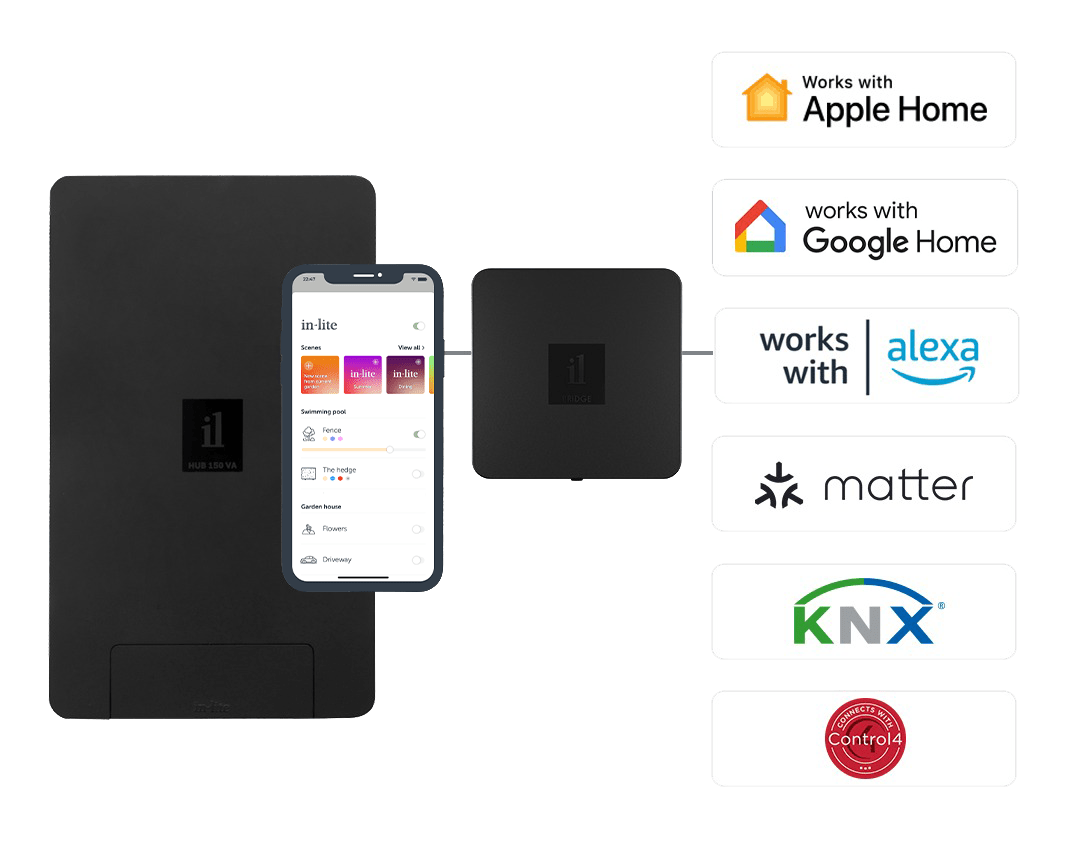
Pair SMART HUB-75, SMART HUB-150 or SMART HUB-300 transformer with the in-lite app to set automated dusk-to-dawn schedules, create up to three independent light zones, and adjust brightness for different occasions. The system integrates with Amazon Alexa, Google Home, Apple HomeKit, GIRA/KNX, or Control4 for voice control. In Canada, where summer days stretch past 9 PM and December light ends before 4:30 PM, automated scheduling means your tree lights adjust to the season without any manual intervention.

Motion-trigger accessories can also be added to the system, activating tree lights when movement is detected along a driveway or pathway useful for front-yard trees that double as security lighting anchor points.

Installation and Maintenance

Step-by-Step Installation Guide

in-lite's 12V system is designed for straightforward outdoor installation. Here's how to approach a typical tree lighting setup.

1. Plan your fixture positions. Walk the yard at night with a flashlight and test the effect from different angles before digging. What looks logical on a plan often reads differently in the dark. Mark positions with stakes.

2. Mount the transformer. Fix the SMART HUB-150 or SMART HUB-300 to an exterior wall near a power outlet. The transformer converts 120V to a safe 12V current.

3. Run the main cable. Route the 12V cable from the transformer to the tree area. Cables can be run through soil, beneath mulch, or along bed edges. In Canadian climates, bury cables below the typical frost penetration depth for your region to prevent damage from ground movement.

4. Position and stake the spotlights. Drive spotlight stakes into the ground at your planned positions. Angle the fixture toward the tree — for uplighting, aim at the lower trunk and let the beam spread naturally through the canopy.

5. Connect with EASY-LOCK. Press the EASY-LOCK connector onto the cable at each fixture point. No tools required. The connector creates a weatherproof contact without cutting the cable.

6. Set up the in-lite app. Pair the SMART HUB with the in-lite app via Bluetooth, create a tree lighting zone, and set your preferred schedule.

For further guidance, visit our installation tips page, or find a certified in-lite dealer near you who offers professional installation.

FAQ

How to choose the right lighting for different tree species? Match the fixture to the tree's height, canopy density, and bark texture. Narrow-beam spotlights suit tall, dense conifers like spruce and pine. Wider beam fixtures work better for open deciduous canopies like birch, aspen, and honeylocust. Trees with distinctive bark — white birch, red maple — reward close placement and grazing light that travels across the bark surface rather than shooting straight up through the canopy.
What are the benefits of using LED tree lighting? LED tree lights produce very little heat, making them safe to use near foliage and root systems. They consume a fraction of the energy of halogen alternatives, and they last significantly longer — in-lite LED fixtures are rated for 50,000+ hours of operation. LEDs also maintain consistent color temperature across their lifespan, so your tree lights look the same in year ten as they did in year one.
What is the difference between uplighting and downlighting for trees? Uplighting places a spotlight at ground level aimed upward into the canopy, creating a dramatic, high-contrast effect that makes the tree a clear focal point after dark. Downlighting positions a fixture above the tree and angles it downward, creating a soft, dappled moonlight effect on the ground below. Uplighting is typically more dramatic and visible from a distance. Downlighting is softer, more atmospheric, and works well in seating and entertaining areas beneath large trees.
How to install outdoor spotlights in trees safely? Always install tree lighting spotlights in the ground, never attached to the tree itself. Position the fixture stake in the soil at your planned location, route the cable back to the transformer, and connect using in-lite's EASY-LOCK tool-free connector. Keep cables below the frost line where possible, and clear of the root zone within the tree's drip line. Visit our installation tips page for full step-by-step guidance.
Can tree lighting damage the health of the tree? Ground-mounted LED tree lighting poses no risk to tree health. in-lite LED fixtures produce minimal heat and are positioned in the soil, not attached to the bark or branches. The only installation practices to avoid are: attaching cables directly to the trunk, trenching through the main root zone, and placing fixtures so close to the base that trunk growth eventually incorporates them. Follow standard installation spacing and check positions annually as the tree matures.
How to hide cables and wires in tree lighting installations? in-lite cables can be buried below the soil surface along bed edges and through planted areas without conduit. In paved or graveled areas, run cables beneath the surface at sufficient depth to avoid freeze-thaw displacement. Within planted beds, cover cables with a layer of mulch. The EASY-LOCK connector system allows cable to be run in a single continuous length with fixture connections tapped off at each point, eliminating the need for multiple cable terminations or exposed junction points.

Find your tree lights

Ready to transform your trees into the focal points they deserve to be? in-lite products are available exclusively through a certified dealer and landscaping professional network across Canada. Your local in-lite dealer can advise on fixture selection, system sizing, and installation for your specific trees and property.

Back to top